EspañolEnglish


Biological nitrogen fixation is one of the main productivity drivers of alfalfa. However, when this process fails due to soil, management, or environmental issues, the crop loses vigor and productivity. In such situations, strategic fertilization can make the difference in sustaining yield and forage quality.
Alfalfa (Medicago sativa L.) is one of the most important forage crops in Argentina and forms the productive foundation of numerous beef and dairy production systems. Its high biomass production capacity, combined with high protein content and excellent digestibility, makes it a strategic species within forage chains. Under favorable conditions and with proper agronomic management, alfalfa can exceed 15 tons of dry matter per hectare per year. However, reaching these productivity levels requires precise nutritional management. Within this framework, nitrogen plays a central role due to its involvement in key physiological processes that determine crop growth, biomass production, and forage quality.
The Role of Nitrogen
Unlike many other crops, alfalfa has the ability to fix atmospheric nitrogen through a symbiotic relationship with bacteria of the genus Sinorhizobium. This process occurs in specialized structures called nodules that develop on the plant roots. Through this biological association, the crop transforms nitrogen from the air into forms available for plant metabolism, which under normal conditions reduces the need for nitrogen fertilization.
Research conducted by INTA shows that properly nodulated alfalfa can fix between 150 and 300 kilograms of nitrogen per hectare per year. This contribution is essential to cover a large portion of the crop’s requirements, which are high due to its elevated protein production.
Nitrogen is especially important for sustaining the development of the leaf canopy, which is primarily responsible for dry matter production. It also plays a key role in tissue regeneration after each cut and in the accumulation of reserves in the crown and roots—processes that are essential for ensuring crop persistence and rapid regrowth.
Addressing Nodulation Problems
When biological fixation functions properly, much of this nitrogen demand is covered by the activity of root nodules. However, there are numerous situations in which this process may be limited or may not occur at all. Under these conditions, nitrogen becomes a limiting nutrient for crop growth.
Nodulation failures may have several causes. Among the most common factors are the absence or low population of specific bacteria in the soil, problems with seed inoculation, inadequate pH levels, nutritional deficiencies—particularly phosphorus or molybdenum—soil compaction, salinity, or conditions of water or thermal stress.
When nodulation is deficient, the crop begins to show clear symptoms of nitrogen deficiency. These include reduced vigor, slow growth, pale green or yellowish leaves, and a decrease in regrowth speed after cutting. These symptoms reflect a reduction in photosynthetic activity and the plant’s metabolic capacity.
In addition to affecting the volume of forage produced, nitrogen deficiency also impacts the nutritional quality of alfalfa. Nitrogen is the main component of plant proteins, so its availability determines the crude protein content of the forage. When the crop lacks this nutrient, the nutritional value of the feed decreases.
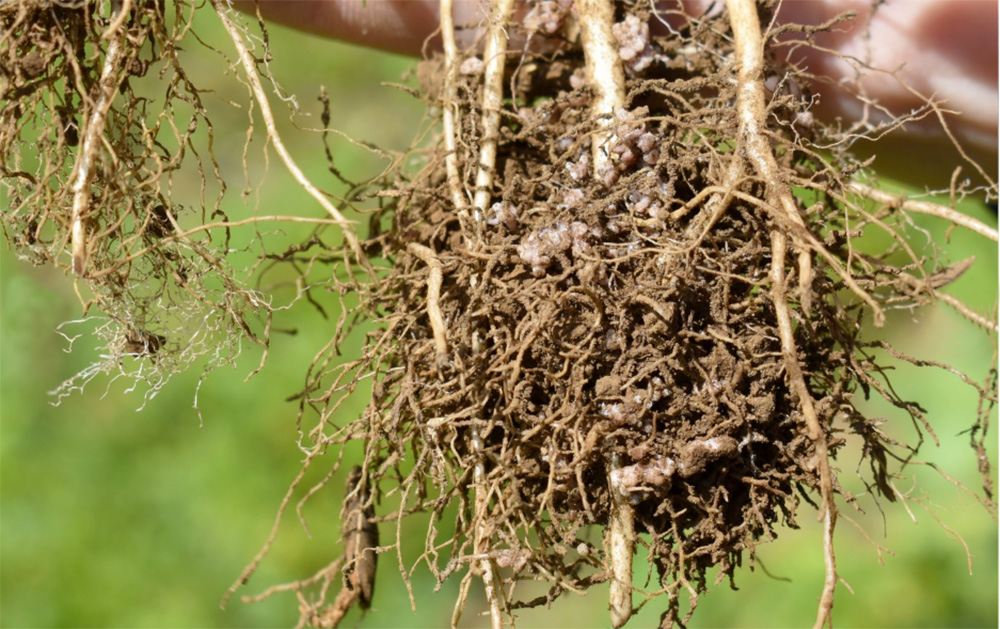
This issue can also occur in other forage legumes used in grazing systems. Species such as red clover, white clover, and lotus also depend on biological nitrogen fixation to meet their nutritional requirements. When nodulation is impaired, these species may experience similar limitations in growth and productivity.
In mixed pastures, where legumes coexist with grasses, poor nodulation of the legume also affects the nitrogen dynamics of the system. Associated grasses depend heavily on the nitrogen supplied by the legume, so a failure in this process reduces the overall productivity of the pasture.
Acting at the Right Time
In this context, when the crop is not nodulating properly, nitrogen fertilization becomes a key agronomic tool. Supplying available nitrogen helps restore the crop’s photosynthetic activity, stimulates leaf growth, and improves regrowth speed after each cut.
In recent years, foliar fertilization has gained prominence as a strategy to complement the nutrition of intensive crops. This practice allows nutrients to be delivered quickly and directly, especially when root absorption may be limited by environmental conditions or by the crop’s physiological status. This characteristic is particularly valuable in frequently cut systems, where recovery speed largely determines annual productivity.
Among the most recent innovations in plant nutrition are fertilizers formulated using nanotechnology. These products use high-purity nanoparticles that have an extremely small size and a large contact surface, improving the absorption and efficiency of applied nutrients. Nanoparticles can pass more easily through the leaf cuticle and be rapidly incorporated into plant metabolism, allowing lower doses to be used while achieving more efficient physiological responses compared with conventional fertilizers.
In this context, MIST N®, developed by Kioshi Stone, stands out as a foliar fertilizer formulated with high-purity nitrogen nanoparticles, designed to supply this nutrient rapidly and efficiently when the crop presents limitations in biological fixation.
Thanks to its nanoparticulate formulation, nitrogen can be quickly absorbed through the leaves and incorporated into plant metabolism, helping restore photosynthetic activity, improve leaf development, and accelerate regrowth recovery after each cut. This characteristic is particularly important in situations where alfalfa is not nodulating properly or when the crop is experiencing stress conditions that affect nodule activity.
Due to the high efficiency of its nanoparticle formulation, MIST N® is recommended at very low application rates, in the range of 1.5 to 2.5 liters per hectare, contributing to more precise, efficient, and sustainable fertilization strategies for modern forage systems.
 - Kioshi Stone.jpg)
Field Evidence: Results from an Alfalfa Trial
The importance of these strategies is reflected in the results of a trial conducted in 2025 by Agronomist MSc. Liliana Clausen in Jesús María, Córdoba. In this study, the productive response of alfalfa to foliar application of MIST N® was evaluated.
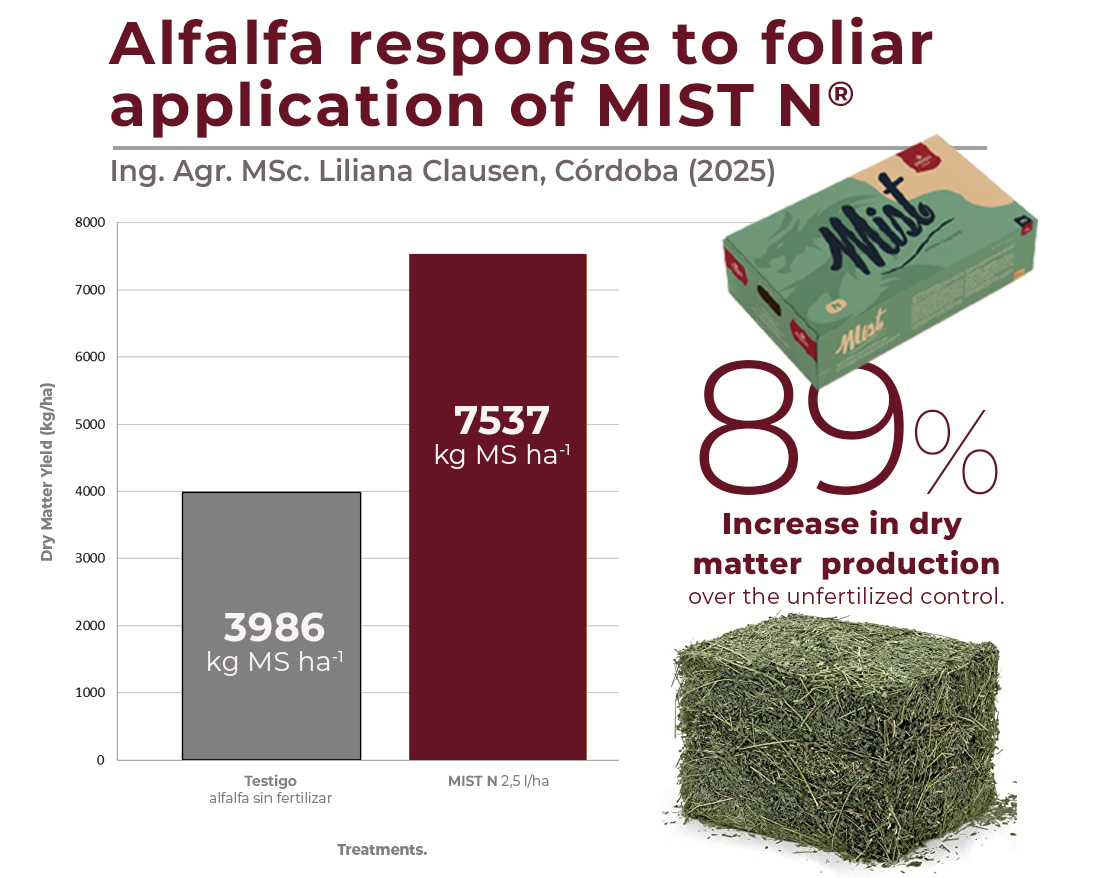
The results showed a significant improvement in dry matter production. The fertilized treatment achieved yields 89% higher than the control, reaching approximately 7,537 kg of dry matter per hectare, confirming the potential of foliar nutrition to enhance crop productivity.