EspañolEnglish

Preparing a field involves more than weed control. Reconditioning the soil environment during the fallow period can improve fertilizer-use efficiency and create better conditions for early crop growth and yield determination. Field trials show that adding MIST TPS 78 to a conventional management program can deliver an additional 785.36 kg/ha.
Approaching the 2026 maize crop solely in terms of hybrid selection, plant density, and nitrogen means considering only part of the system. The crop needs soil capable of storing water, exchanging gases, and supplying nutrients at the right time. When roots encounter acidity, compaction, low porosity, or imbalanced fertility, they explore a smaller volume of soil. The consequences become evident in early growth, kernel number determination, and final yield.
Well-aggregated soil allows more water to infiltrate and be retained, supports root growth, and improves nutrient cycling.
Soil health is the soil’s capacity to function as a living ecosystem. This condition provides greater resilience to irregular rainfall, heat stress, and temporary water excess. For maize, healthy soil is the platform that converts natural resources and agricultural inputs into grain.
What Argentine Soils Show Today
The most recent survey of the Pampas Region, conducted across 570 sites by INTA, CONICET, the National University of Mar del Plata, and Fertilizar Asociación Civil, confirms a cumulative deterioration in soil quality.
In the top 20 centimeters, organic matter ranged from 2.25% to 3.97%, representing levels 15% to 34% below those found in native soils. Soil pH ranged from 5.99 to 6.4 and was 5% to 9% lower than the original values.
One of the main management-related causes of this acidification is the repeated use of soluble nitrogen fertilizers that contain or generate ammonium, particularly urea. Although urea is not technically an ammonium salt, it is converted into ammonium after application. During the subsequent nitrification of ammonium to nitrate, protons(H⁺ ions) are released, progressively lowering soil pH. This effect accumulates over the years and becomes more pronounced when high application rates are used.
A continuous maize trial established by INTA Paraná in 1995,* involving increasing urea rates, identified acidification as the main long-term chemical change, particularly in the top five centimeters of soil.
*INTA, Long term trial on continuous nitrogen fertilization in maize, published in 2024.
The consequences are interconnected. Acidification alters the availability and balance of phosphorus, calcium, magnesium, potassium, and molybdenum; changes the composition and activity of soil microorganisms; and, as pH continues to decline, increases the solubility of aluminum and manganese to potentially toxic levels. It also restricts root elongation and soil exploration, reducing the crop’s ability to take up water and nutrients.
In maize, this deterioration can result in lower early vigor, reduced tolerance to periods of water stress, lower fertilizer use efficiency, and a tangible limitation on yield.
Phosphorus is one of the main causes for concern. Bray extractable phosphorus values ranged from 13 to 18 mg/kg, with minimum levels below 10 mg/kg in the eastern Pampas. Approximately 60% of cultivated soils, about 18.2 million hectares, have phosphorus levels within the yield limiting range.
Exchangeable calcium and magnesium levels have declined relative to 2018 and are now nearly 50% below those found in native environments. Areas with lower potassium levels have also been identified, while 32% of the cultivated area recorded very low to low zinc levels.
Chemical, Physical, and Environmental Degradation
Fertility loss does not occur in isolation. Poorly diversified crop rotations, periods without living roots, insufficient crop residue, machinery traffic under unsuitable soil moisture conditions, and tillage practices that leave the soil exposed all reduce soil carbon, aggregate stability, and water infiltration.
Compaction restricts root growth, surface crusting hampers crop emergence, and erosion removes the most fertile soil fraction.
Climate extremes amplify these problems. Intense rainfall on bare soil increases runoff and nutrient losses, while drought and high temperatures accelerate crop stress in soil profiles with low organic matter content.
The FAO warns that nearly 1.4 billion hectares are already affected by salinity and ranks Argentina among the ten countries that account for 70% of the world’s salt-affected soils. Soil diagnosis must therefore identify deficiencies, excesses, and site-specific environmental variability.
Reconditioning the Soil Before Planting
Restoring soil health does not mean applying a one-size-fits-all recommendation. The first step is measurement.
During the 2023/24 crop season, only 24% of maize growers conducted soil testing before fertilization, according to ReTAA. Soil diagnosis remains a minority practice, even though it determines the efficiency of every subsequent investment.
For maize, soil diagnosis should include pH, electrical conductivity, organic matter, phosphorus, nitrogen, sulfur, cation exchange capacity, calcium, magnesium, potassium, sodium, and depending on the region, zinc and boron. Plant available water, infiltration, compaction, and effective rooting depth should also be evaluated. A single surface soil sample may not adequately explain the influence of a shallow water table or a drainage constraint.
Based on this information, the management program can combine balanced fertilization, the amelioration of soil acidity or sodicity, more intensive crop rotations, cover crops, permanent soil cover, and controlled machinery traffic.
The goal is to reach planting with a functional pore network, readily available nutrients, and roots capable of exploring the soil profile.
Monoammonium phosphate(MAP) and urea are key components of maize nutrition, but they cannot, on their own, correct sulfur, calcium, magnesium, or micronutrient deficiencies, nor can they overcome physical soil constraints. Argentine evidence presented in 2026 shows that comprehensive crop nutrition strategies increased maize yields by up to 20% compared with commonly used management practices in semiarid and subhumid environments.

MIST TPS 78: A Tool for Preparing the Rooting Environment
MIST TPS 78 is a neutral-reaction dispersion of high purity mineral nanoparticles based on calcium and sulfur. It is characterized by its availability, residual effect, and ability to help displace sodium and soluble salts, improve soil structure, and reduce compaction and surface crusting.
According to the report on the product evaluated by the National University of Lomas de Zamora, it contained 14.34% calcium, 11.86% sulfur, and 3.42% magnesium. The product was applied at a rate of 3 L/ha during the fallow period.
The 2025/26 trial was conducted in Lobos on a soil with a pH of 5.65, a low phosphorus level of 8.9 ppm, 5% organic matter, and limited drainage.
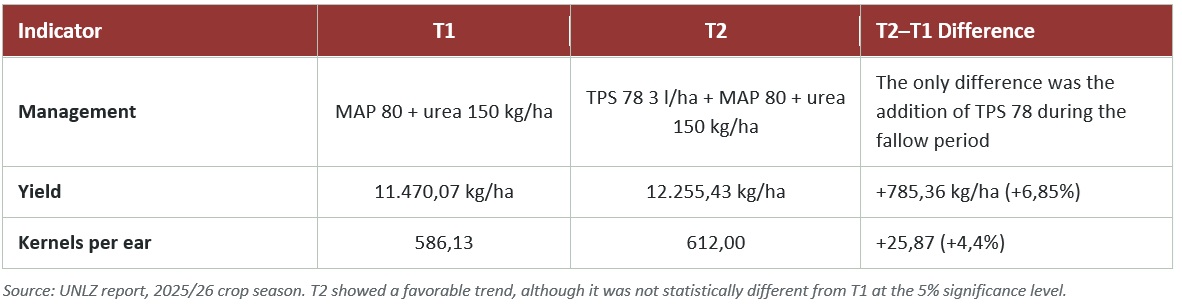
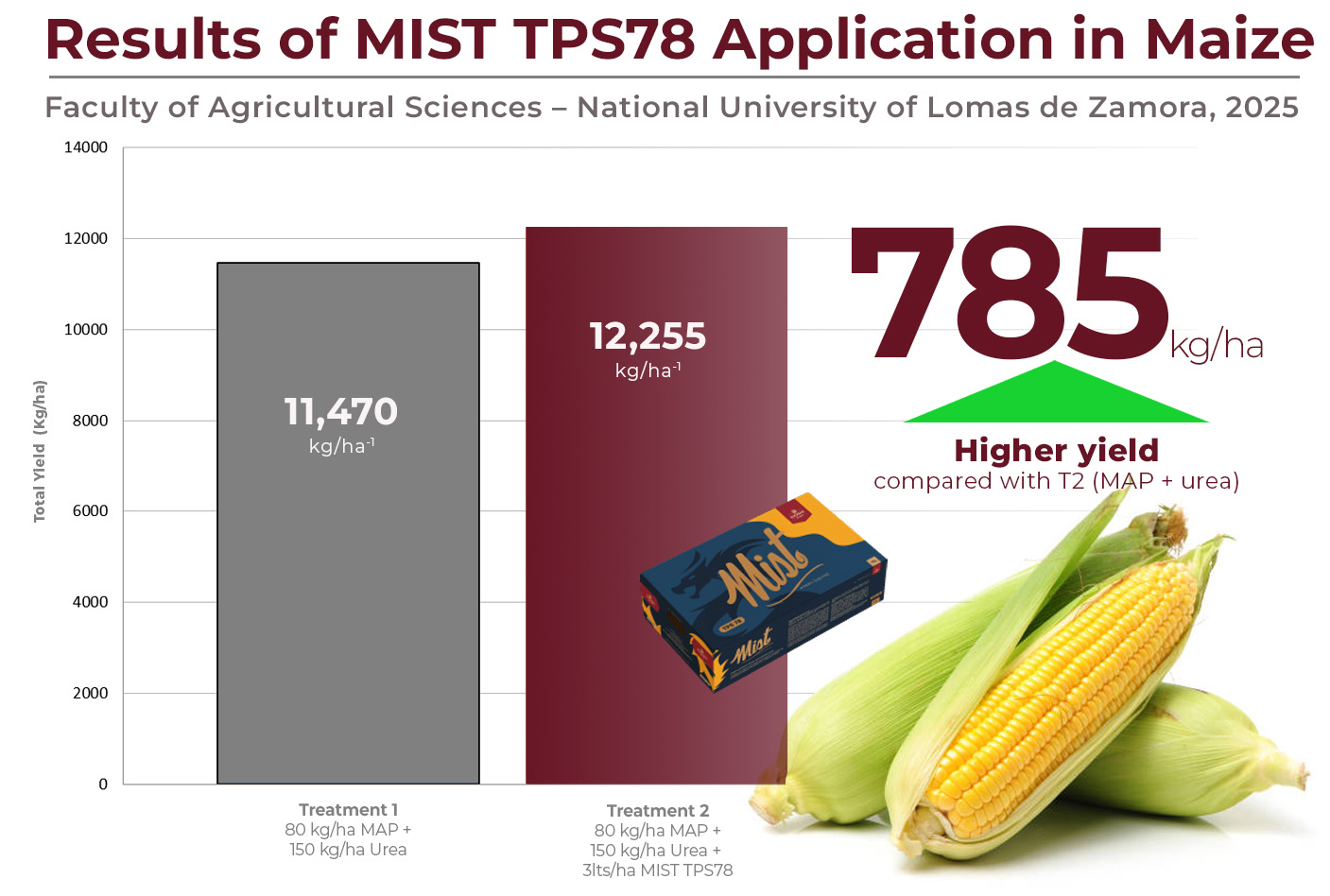
Treatment T1 received 80 kg/ha of MAP at planting, followed by 150 kg/ha of urea between the V4 and V6 growth stages. Treatment T2 maintained the same nutrient program and added TPS 78 at 3 L/ha during the fallow period. This comparison made it possible to isolate the effect of the pre-planting intervention.
T2 yielded 12,255.43 kg/ha, compared with 11,470.07 kg/ha for T1. This represented an additional 785.36 kg/ha, or a 6.85% improvement, from a single application.
Kernel number also increased from 586.13 to 612.00 kernels per ear, representing a 4.4% increase. Thousand-kernel weight did not account for the yield response; the advantage was associated with a higher number of kernels.
The Goal Is Not to Apply More Fertilizer, but to Capture More Yield Potential
The message for the 2026 maize crop is clear: the first step is to build the soil environment in which the crop can respond.
Reconditioning the soil increases the likelihood that water, fertilizer, and genetic potential will be converted into yield. Within a diagnosis-based management strategy, TPS 78 showed that an intervention during the fallow period can complement a MAP plus urea program and increase productivity.
Soil is not merely the medium that supports the crop; it is the first component of yield.