EspañolEnglish


When the crop enters stem elongation, nitrogen demand accelerates and nutrient availability becomes decisive. Foliar fertilization emerges as a strategic tool to improve efficiency, sustain photosynthesis, and support grain number determination.
Argentine wheat has come through recent seasons that have once again highlighted the value of agronomic management. When environmental conditions are favorable, the difference between an average field and a high-yielding one is often explained by fine-tuned decisions: sowing date, variety selection, crop health, available soil water, starter nutrition and, especially, nitrogen management. At this point, the discussion is no longer only about how much nitrogen to apply. Today, the technical focus is on Nitrogen Use Efficiency, known as NUE: in other words, what proportion of the available nutrient is actually captured by the crop and transformed into biomass, spikes, grains and protein.
Z31: the stage when demand begins to define yield
Within the wheat cycle, stage Z31, first visible node, beginning of stem elongation, marks a decisive physiological transition. Up to that point, the crop has been building its structure: establishment, tillering, canopy cover and root exploration. But from Z31 onward, a more accelerated growth phase begins, during which the plant increases its biomass accumulation rate and starts defining components that will have a direct impact on final yield.
At this stage, available nitrogen plays a strategic role. On the one hand, it sustains the photosynthetic activity of the canopy, helping maintain functional leaves with higher chlorophyll content and greater capacity to intercept radiation. On the other hand, it supports tiller survival, leaf expansion and the development of reproductive structures. In wheat, a large part of yield is explained by the number of grains per square meter, and this component is built before flowering, during the period when the crop defines fertile spikes, viable florets and its capacity to sustain growth.
Foliar fertilization at this stage should not be seen as a late correction, but as a tool to support the sharp increase in demand that occurs when wheat shifts from building vegetative structure to defining yield.
From applying more to applying better
NUE requires a more precise view of the system. A high nitrogen rate does not necessarily mean higher efficiency if a significant portion of the nutrient is lost, immobilized or arrives too late in relation to crop demand.
From a physiological standpoint, nitrogen top-dressing at Z31 seeks to sustain three key processes. First, the generation and maintenance of active leaf area, which will be responsible for capturing radiation during the critical period. Second, biomass accumulation before flowering, which is directly related to grain number. Third, nitrogen availability for remobilization to the grain during later stages, with an impact on protein content and commercial quality.
Proper fertilization does not simply mean reaching a certain total amount of nitrogen per hectare. It means ensuring that the nutrient is available when the crop is able to absorb it and convert it into yield.
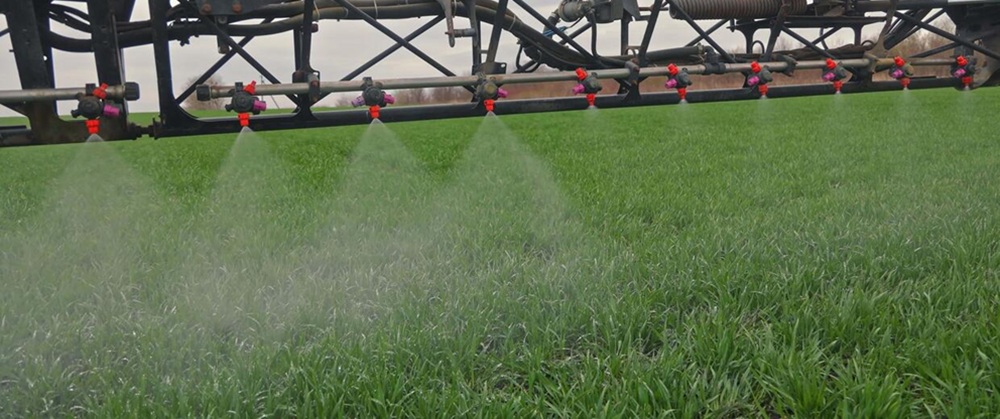
Foliar fertilization: precision for high-demand stages
In this context, foliar fertilization becomes increasingly relevant as a complement to basal strategies. Its main advantage is that it allows nutrients to be supplied rapidly and directly to plant tissue, improving the synchrony between nutrient supply and crop demand at moments when the crop needs to sustain metabolic activity.
Nanoparticulate technology adds an important differential. High purity, reduced particle size formulations promote better dispersion, contact and absorption, allowing for more precise rates and greater physiological efficiency. In high-potential wheat systems, this characteristic is especially interesting for Z31 top-dressing, when the crop already has enough leaf area to capture the application and, at the same time, is going through a stage of strong nutritional demand.
Kioshi Stone’s MIST N® fits within this approach as a nitrogen foliar tool based on high purity nanoparticle technology. Its technical proposal is based on supplying highly efficient nitrogen, together with complementary nutrients such as calcium, magnesium and sulfur, which are involved in processes linked to absorption, photosynthesis, amino acid synthesis and plant metabolism. MIST N is a mineral suspension in which nitrogen is contained in a nano-mineral emulsion, allowing gradual release and higher fertilization efficiency.
MIST N in high-nitrogen nutrition systems
When wheat already has a strong basal nutrition program, the technical question is not whether the crop received nitrogen, but whether that nitrogen was sufficient and available at the right time. In high-potential environments, a strategy based on DAP at sowing and early urea can sustain very good yield levels, but foliar top-dressing at Z31 can provide an additional benefit when the crop enters a phase of higher demand.
In the wheat trial carried out in Tandil, the crop was managed with a base application of 100 kg/ha of DAP at sowing, 200 kg/ha of urea at Z11 and a foliar nitrogen application at Z31. Fertilized treatments exceeded 8,000 kg/ha, and the treatment that included foliar MIST N at 3 L/ha at Z31 stood out with a 406 kg/ha increase compared with the DAP plus urea program.
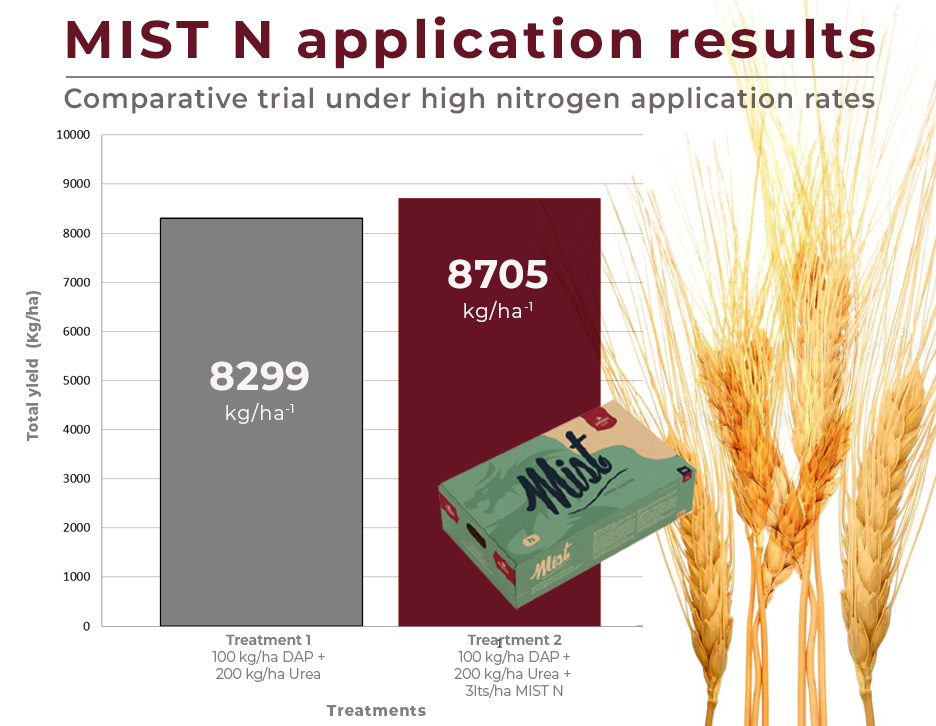
This result is relevant because it does not show a response under a deficient nutrition scenario, but rather within a high-nutrition system. In other words, even with 100 kg/ha of DAP plus 200 kg/ha of urea, the inclusion of MIST N at Z31 improved yield. The agronomic interpretation is clear: when the crop expresses high potential, nitrogen efficiency and timing can be just as important as the total rate applied.