EspañolEnglish

Wheat is an extremely efficient crop when nitrogen (N) is properly managed. For this reason, modern agronomic management is shifting toward dynamic strategies, where nutrition is adjusted according to crop status and environmental conditions. Refertilization is no longer a secondary practice but has become a central decision within the production system.
The most recent wheat season delivered a clear signal: one of the best harvests in recent history, with production levels reflecting not only favorable weather conditions across large regions, but also a sustained improvement in crop management. This record production scenario is not accidental. It results from an evolution in technical decision-making, where nutrition, and particularly nitrogen management, plays a central role. In this context, Nitrogen Use Efficiency (NUE) is consolidating as one of the key pillars to sustain and scale these yield levels, marking the transition from a dose-based approach to an efficiency-driven one.
Nitrogen is the primary driver of wheat growth. Its role in the synthesis of chlorophyll, proteins, and enzymes makes it a determining nutrient in the crop’s ability to produce biomass and convert radiation into yield.
It is not only about how much nitrogen is applied, but how much of that nitrogen is ultimately converted into yield. In the productive systems of the Pampas region, a significant portion of applied nitrogen is lost through volatilization, leaching, or immobilization, which substantially reduces system efficiency. Therefore, the current challenge is to synchronize nitrogen supply with crop demand, avoiding both deficiencies and unnecessary losses.
The importance of efficient refertilization
Within this framework, nitrogen refertilization emerges as a strategic tool. Base fertilization is essential to ensure proper crop establishment, but in many cases it is not sufficient to sustain demand during later growth stages. Refertilization allows nutrition to be adjusted according to environmental conditions, climate, and crop status, effectively accompanying its physiological dynamics.
However, traditional nitrogen sources present limitations that constrain their efficiency. Urea, for instance, depends on specific environmental conditions for proper incorporation and can suffer significant losses under low moisture or lack of rainfall. This leads to a mismatch between nutrient availability and actual crop requirements, especially in seasons with high climatic variability.
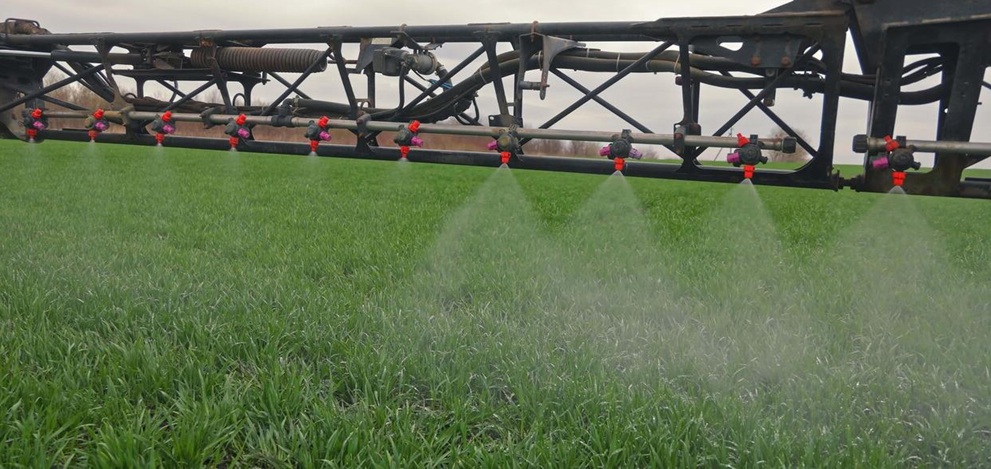
In response to these limitations, foliar fertilization stands out as a highly efficient alternative within refertilization strategies. By entering directly through the leaf, nitrogen can be rapidly and effectively absorbed, regardless of soil conditions. This allows for more precise responses to critical crop stages, sustaining growth when demand is high.
The incorporation of nanotechnology into foliar fertilization represents a qualitative leap in efficiency. Due to their reduced size and high purity, nanoparticle-based formulations achieve greater penetration into plant tissues and more efficient absorption. In this context, MIST N® from Kioshi Stone stands out as an innovative tool, capable of supplying nitrogen in an immediate and highly available form, improving the efficiency of the nutritional process and supporting the crop in real time.
Strong field results
Field data support this approach. Trials conducted in Balcarce, Buenos Aires, compared two nutritional strategies. Treatment 1 consisted of 120 kg/ha of DAP at sowing + 130 kg/ha of urea at Z13 + 130 kg/ha of urea at Z23. Treatment 2 replaced the second urea application with 4 L/ha of MIST N® at the end of tillering. To evaluate the results, NUE was calculated using the standard formula: yield of the fertilized treatment minus yield of the control, divided by the applied nitrogen rate (kg/kg).
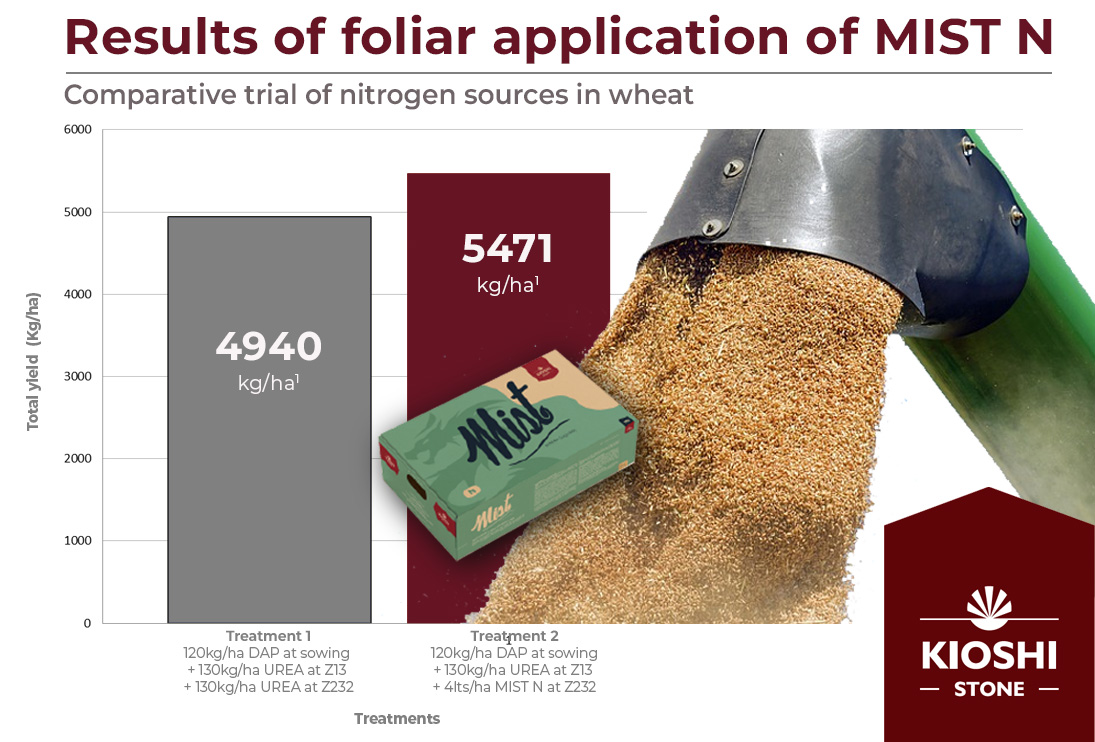
The results demonstrated that the treatment based on foliar applications with nanoparticle technology outperformed the traditional scheme. In particular, Treatment 2 (DAP + Urea + MIST N®) clearly exceeded Treatment 1, showing that the improvement does not come from applying more nitrogen, but from applying it at the right time and with a technology that optimizes its absorption. This difference translated into greater biomass accumulation, improved crop development, and an increase in final yield.