
More Biomass at Every Regrowth: Smart Nutrition to Boost Alfalfa
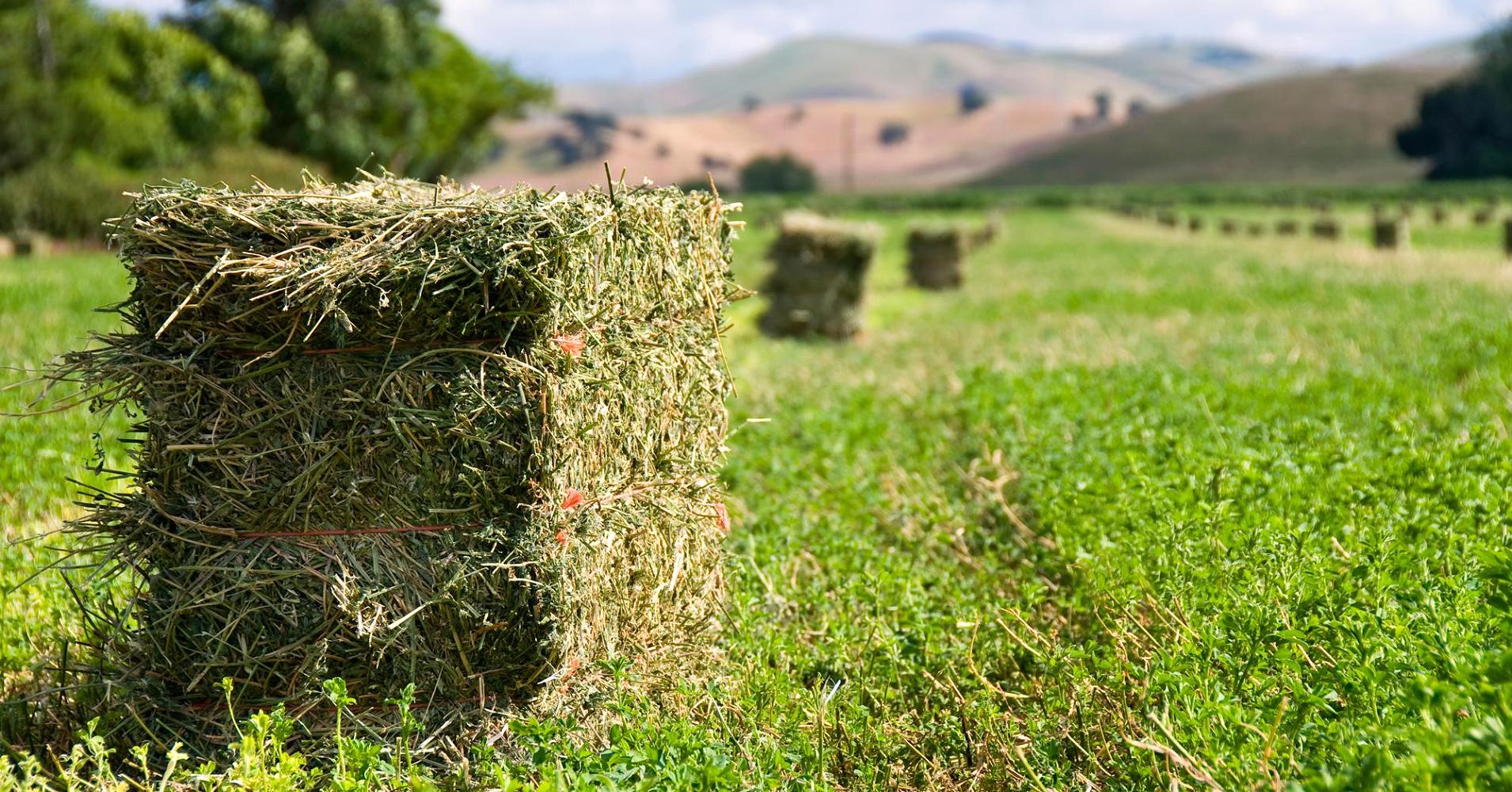
Alfalfa is experiencing a historic phase of productive and export expansion, which demands increasingly precise management schemes. Efficient nutrient replenishment after cutting and the incorporation of foliar technologies with high-purity nanoparticles, such as MIST PRD®, make it possible to transform nutrition into a concrete tool for improving yield, stability, and efficiency in intensive forage systems.
Alfalfa is, unquestionably, the “queen of forages”: a perennial crop essential to intensive beef and dairy systems, combining high yields with superior nutritional quality. According to recent estimates, Argentina has between 3 and 3.5 million hectares planted with alfalfa, ranking as the world’s second-largest producer, only behind the United States.
In this context, mineral nutrition shifts from being a complement to becoming a key management tool, especially after each cut, when the crop must rapidly reorganize its canopy and rebuild reserves.
Alfalfa’s yield potential is determined by the environment’s capacity to provide radiation, temperature, and water, but also by the availability of essential nutrients that sustain regrowth. Each cut implies a significant extraction of elements from the soil–plant system, and if these are not efficiently replenished, productivity declines, cycles shorten, and stand longevity is compromised. Calcium, magnesium, sulfur, nitrogen, phosphorus, and silicon play specific and complementary roles in this process.
The Role of Nutrients in Post-Cut Dynamics
Alfalfa productivity and persistence rely on balanced mineral nutrition, in which nutrients act in an integrated and complementary manner, particularly during the periods following each cut, when the crop must quickly reorganize its aerial structure and restore reserves. Nitrogen is the main driver of biomass and protein production, promoting the emergence of new shoots and vegetative growth, while phosphorus is critical in energy transfer processes, cell division, and root system reactivation—key aspects for accelerating regrowth and restoring photosynthetic capacity. Calcium plays a fundamental structural role in the formation and stability of cell walls, in meristem function, and in stand longevity, especially in intensive systems where nutrient removal is high.
Foliar Nutrition and Nanoparticles: A Precision Tool
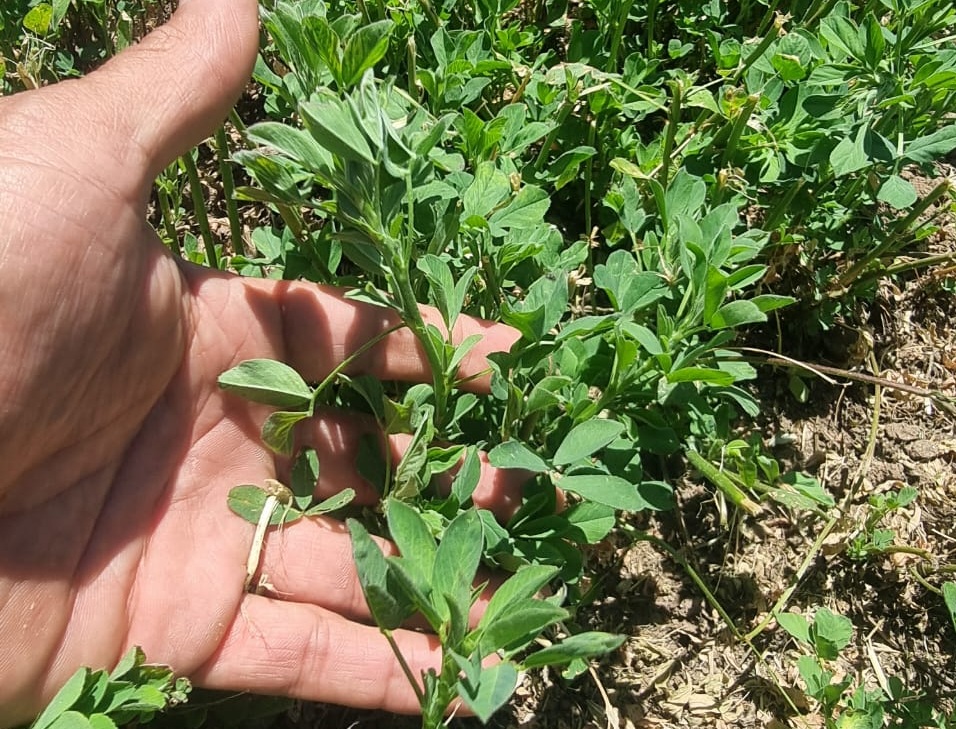
In systems where alfalfa undergoes multiple cuttings, foliar nutrition stands out as a high-value complementary strategy. It allows synchronization between nutrient supply and periods of greatest physiological demand, particularly immediately after cutting, when root uptake may be limited.
In this context, technologies based on high-purity nanoparticles mark a turning point in foliar nutrition efficiency. Products such as MIST PRD® incorporate nano-particulate formulations that enhance absorption, mobility, and availability of strategic nutrients, maximizing the impact of each application. Their design is aimed at supporting the crop during critical post-cut regrowth stages, enhancing productive response without causing imbalances or losses due to over-application. MIST PRD® is a complex liquid foliar fertilizer specifically developed for pasture nutrition, providing a balanced combination of macro-, secondary, and micronutrients essential for growth and root system regeneration, including calcium, magnesium, sulfur, nitrogen, phosphorus, and silicon. Thanks to the high efficiency of its nanoparticle-based formulation, MIST PRD® is recommended at very low application rates, on the order of 1.5 to 2 liters per hectare, contributing to precise, efficient, and sustainable fertilization programs.

Field Evidence: Alfalfa Trial Results
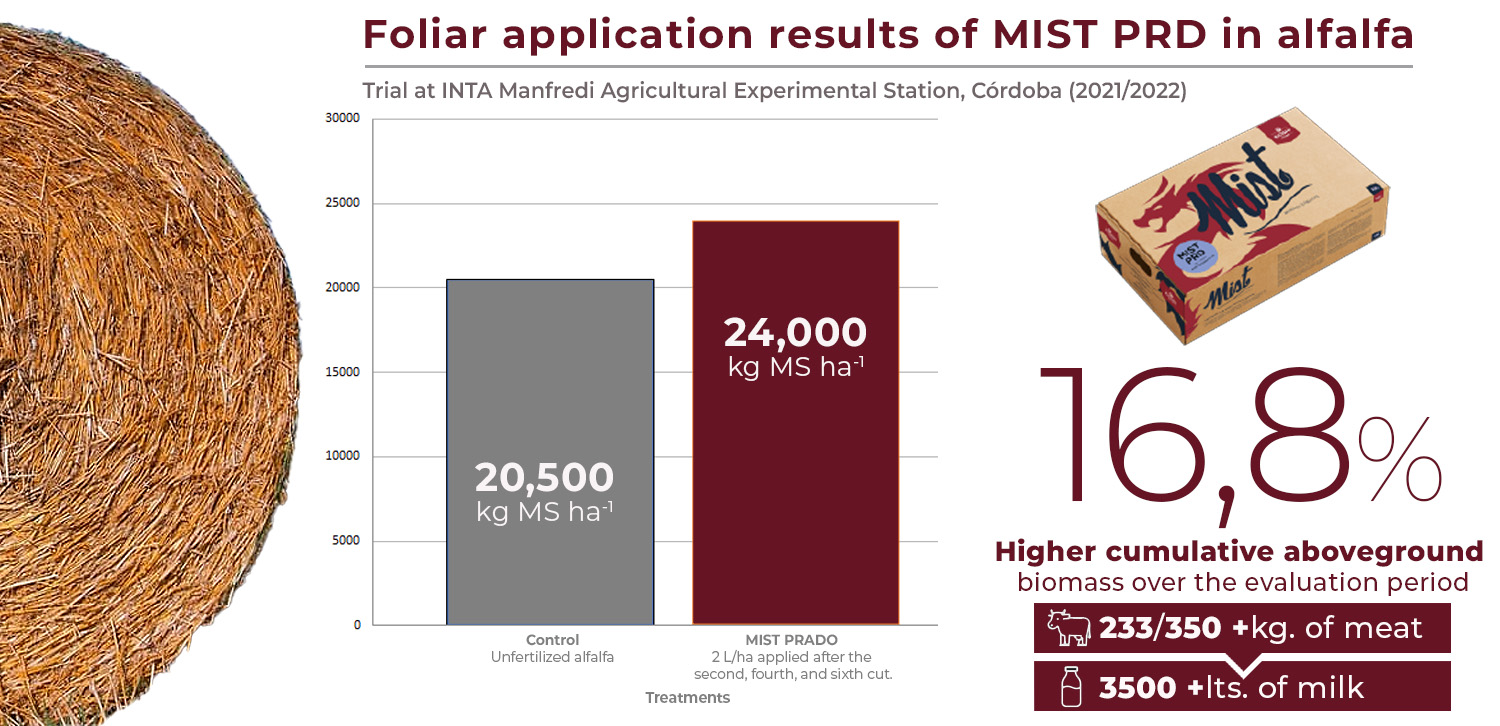
The relevance of these strategies is reflected in the results of a trial conducted at the INTA Manfredi Agricultural Experimental Station in Córdoba, where alfalfa’s productive performance in response to MIST PRD® application was evaluated. The study, carried out during the 2021–2022 cycle on a crop established in March, included seven cuttings and product applications after the second, fourth, and sixth cut.
Results show that cumulative above-ground biomass production was more than 16% higher in the fertilized treatment compared with the control, reaching values close to 24,000 kg of dry matter per hectare. Even more significant was the response in regrowth following application, with average increases of 30% in yield per cut, highlighting a clear synergy between foliar nutrition and regrowth dynamics.
Integrated Management to Sustain Efficient Alfalfa Systems
Field experience demonstrates that alfalfa responds consistently to nutritional strategies aligned with its physiology. After each cut, the crop enters a critical period that determines the speed and quality of regrowth. At that moment, having a balanced nutrient supply allows for sustained high growth rates, improved radiation capture, and extended stand longevity.
The incorporation of technologies such as MIST PRD®, based on high-purity nanoparticles, adds precision and efficiency to these programs, aligning with production systems that seek to maximize results without compromising sustainability. In a scenario where every kilogram of dry matter and every percentage point of protein matter, strategic nutrition ceases to be a cost and becomes a key investment in Argentine alfalfa production.